"What's the ROI?" Is the Right Question. Here Are Real Numbers.
The number one question Singapore business owners ask about AI is not "how does it work?" It is "what is the return on investment?" Fair enough. You are running a business, not a technology experiment.
This guide provides concrete ROI calculations for the most common AI applications, using real numbers relevant to Singapore businesses. No vague percentages. No theoretical projections. Just the maths.
ROI of AI Phone Answering
This is typically the highest and fastest ROI of any AI application for service businesses.
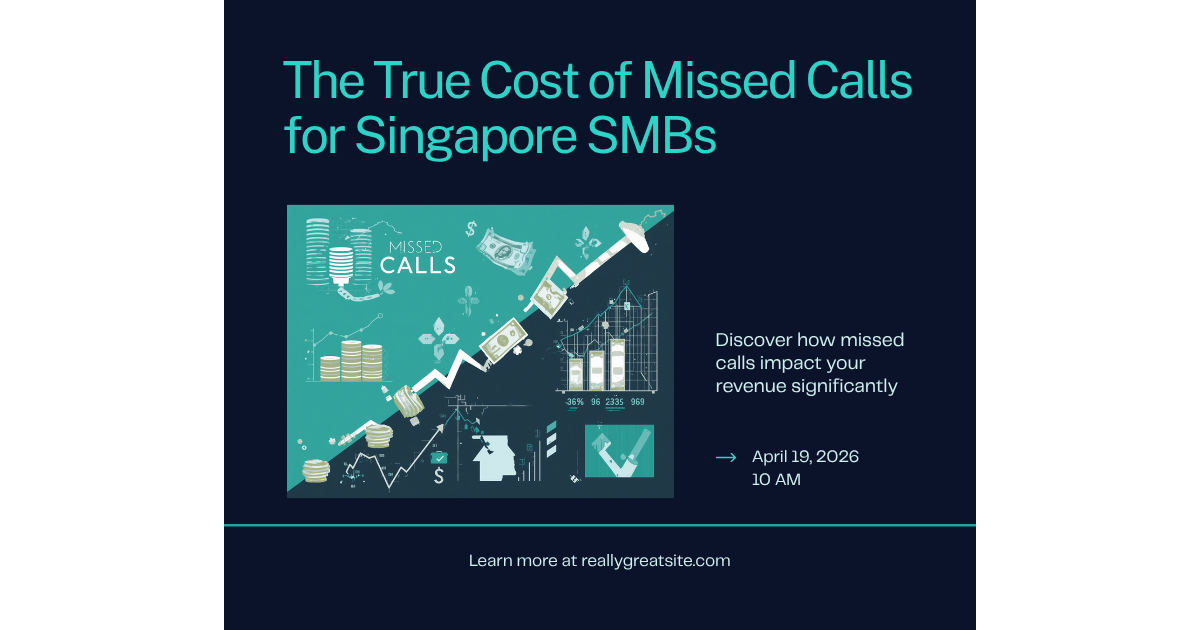
Consider a dental clinic receiving 40 calls per day. Industry data shows 20 to 30 percent go unanswered, so approximately 10 missed calls daily. Average appointment value is SGD 180. Even assuming only 40 percent of missed callers would have booked, the clinic is losing 4 appointments per day, or SGD 720 daily in recoverable revenue.
Monthly lost revenue: approximately SGD 18,700 (26 working days).
An AI receptionist costs a small fraction of that per month. Even in the first week, the revenue recovered from captured calls exceeds the monthly cost of the system.
Payback period: typically under one week.
For F&B, the numbers are similar. A restaurant missing 5 reservation calls per day at SGD 200 per table loses approximately SGD 1,000 daily. At 30 percent conversion, that is SGD 300 per day or SGD 7,800 per month.
For home services, missing 3 calls per day at SGD 250 average job value with 50 percent conversion equals SGD 375 daily or SGD 9,750 per month.
Our detailed missed call cost analysis provides the full framework for calculating your specific numbers.
ROI of AI Search Optimisation (AEO)
AEO ROI is measured differently because it builds over 60 to 90 days rather than delivering immediate results. The calculation focuses on customer acquisition cost comparison.
A DTC brand we worked with was spending approximately SGD 15 per customer acquisition through Meta ads and SGD 8 through Google Ads. After implementing AEO, AI referral traffic began generating customers at effectively zero marginal cost because the investment was a fixed project fee.
In the first 90 days post-activation, AI referral traffic generated enough customers to recover the entire AEO engagement cost. Every customer acquired through AI search after that point had a marginal acquisition cost of zero.
The compounding effect matters here. Unlike paid advertising where traffic stops when you stop spending, AI visibility persists. Once you are established in AI recommendations, you continue to receive referrals without additional spending (though ongoing monitoring is recommended to maintain your position).
Payback period: typically 60 to 120 days for the activation sprint cost.
ROI of No-Show Reduction
AI-powered appointment reminders via WhatsApp consistently reduce no-shows by 30 to 50 percent across Singapore service businesses.
For a beauty salon with 25 daily appointments at SGD 80 average value and a 15 percent no-show rate, the baseline monthly loss to no-shows is approximately SGD 7,800 (3.75 no-shows per day times 26 days times SGD 80).
Reducing no-shows from 15 percent to 8 percent (a conservative 47 percent reduction) recovers approximately 1.75 appointments per day, or SGD 140 daily, or SGD 3,640 per month.
The cost of an AI reminder system is typically a small monthly fee, making the ROI multiple significant.
Payback period: first month.
ROI of AI Customer Service (Chatbots)
AI chatbot ROI is primarily measured in time savings and customer satisfaction.
A retail business receiving 100 WhatsApp enquiries per day, with staff spending an average of 4 minutes per enquiry, dedicates approximately 6.7 hours per day to message handling. An AI chatbot that resolves 65 percent of enquiries without human intervention saves approximately 4.3 hours per day.
At a customer service staff cost of SGD 3,000 per month, recovering 4.3 hours per day (roughly half a full-time equivalent) delivers savings of approximately SGD 1,500 per month.
Additional ROI comes from faster response times (seconds vs minutes), 24/7 availability, and consistent quality of responses.
Payback period: first to second month.
How to Calculate Your Own ROI
The framework is simple for any AI application. First, quantify the current cost of the problem (lost revenue from missed calls, staff time spent on repetitive tasks, customers lost to no-shows). Second, estimate the improvement the AI will deliver (based on industry benchmarks and provider data). Third, compare the monthly cost of the AI solution to the monthly value of the improvement.
For most Singapore SMBs evaluating phone AI, the ROI is so clear that the only real question is "why did I not do this sooner?" For AEO, the ROI takes longer to materialise but compounds over time. For chatbots and automation, the ROI is moderate but reliable.
The ROI of Not Adopting
There is also a cost to inaction. Every month without AI phone answering is a month of lost bookings that went to competitors. Every month without AEO is a month where competitors are building AI citation positions you will later have to fight to displace. Every month of manual processes is a month of staff time spent on tasks that AI handles better and faster.
The businesses that adopt AI early do not just save money and capture revenue. They build competitive advantages that compound over time and become increasingly expensive for late adopters to overcome.
For guidance on which AI to adopt first, read our decision framework.
Talk to Us
Chat with us on WhatsApp to discuss your specific ROI opportunity. We reply within one Singapore business day.